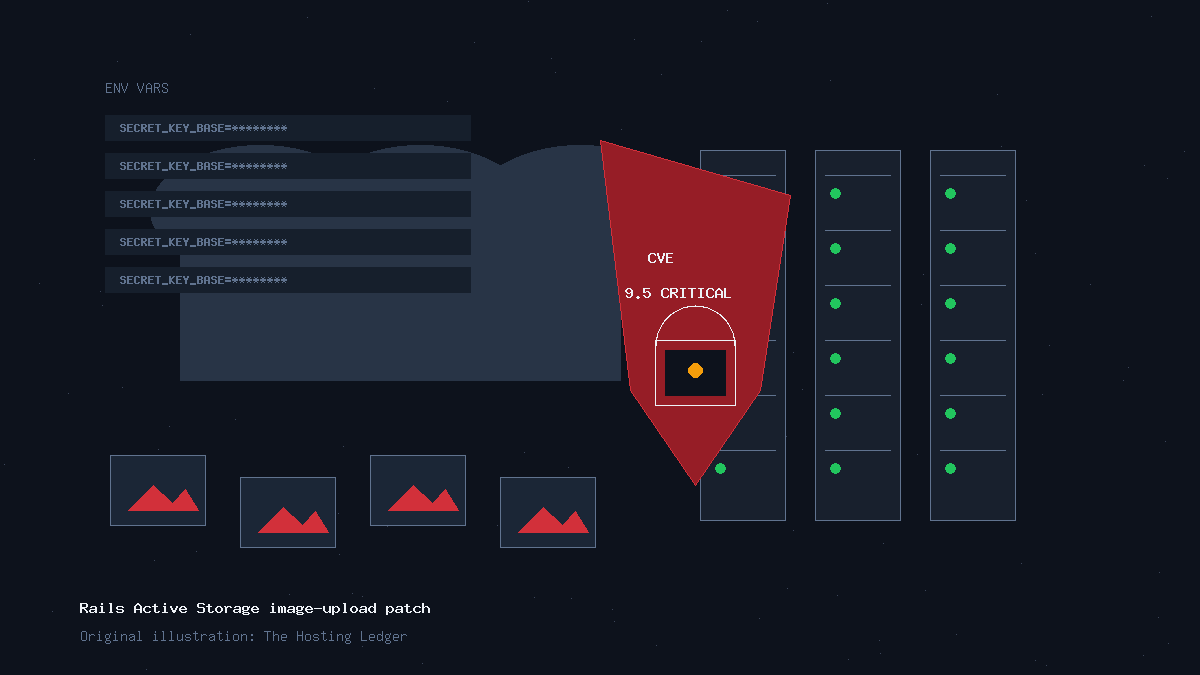
Ruby on Rails maintainers have shipped security updates for a critical Active Storage flaw that matters most to hosted apps accepting user-supplied images. The issue, tracked as CVE-2026-66066, affects Rails applications using Active Storage with libvips when untrusted users can upload images.
The National Vulnerability Database describes the bug as a failure to disable unsafe libvips operations for untrusted content. A crafted upload could cause the Rails process to read files it can access, including environment variables and application secrets. NVD’s entry carries a CVSS 4.0 score of 9.5, rated critical.
For hosting teams, the important detail is not the framework branding; it is the deployment pattern. A multi-tenant VPS, managed app platform, agency server, or container host may have Rails sites that treat image upload as routine plumbing. If those apps keep secrets in environment variables, credentials exposed through the Rails process could become the next step toward account takeover, remote code execution, or lateral movement.
Fixed Rails versions are 7.2.3.2, 8.0.5.1, and 8.1.3.1, according to the advisory references. Rails operators should upgrade rather than rely on upload filtering alone, then rotate any credentials that may have been exposed if logs, application behavior, or suspicious uploads suggest exploitation.
What site operators should check
- Whether any Rails applications use Active Storage with the
libvipsprocessor. - Whether public, customer, or unauthenticated image uploads are enabled.
- Whether production secrets, object-storage tokens, SMTP credentials, or API keys are readable by the Rails process.
- Whether patched Rails versions have been deployed across staging, workers, background jobs, and web nodes.
Shared hosting customers are unlikely to patch Rails itself directly, but VPS, PaaS, and managed application customers should confirm the framework version in their deployed bundle or image. Hosts with Rails support should treat this as an inventory problem: find exposed upload paths first, then verify patched gems everywhere the app runs.
Sources: NVD CVE-2026-66066; Rails GitHub security advisory GHSA-xr9x-r78c-5hrm; Rails 8.1.3.1 release.